
Manufacturing automation scoped to your constraint, not a catalog
Manufacturing automation replaces manual, repetitive, or error-prone production steps with engineered systems — from a single automated station to a coordinated line. The problem it removes is rarely just labor cost; more often it is the variability, the bottleneck that caps throughput, and the tribal knowledge that leaves when a key operator does.
Willowark starts with the constraint. We walk the process, time it, and find where minutes and defects actually come from before proposing hardware. The result is automation scoped to a payback calculation you can check — sometimes a robot cell, sometimes a sensor and a conveyor interlock that costs a tenth as much.
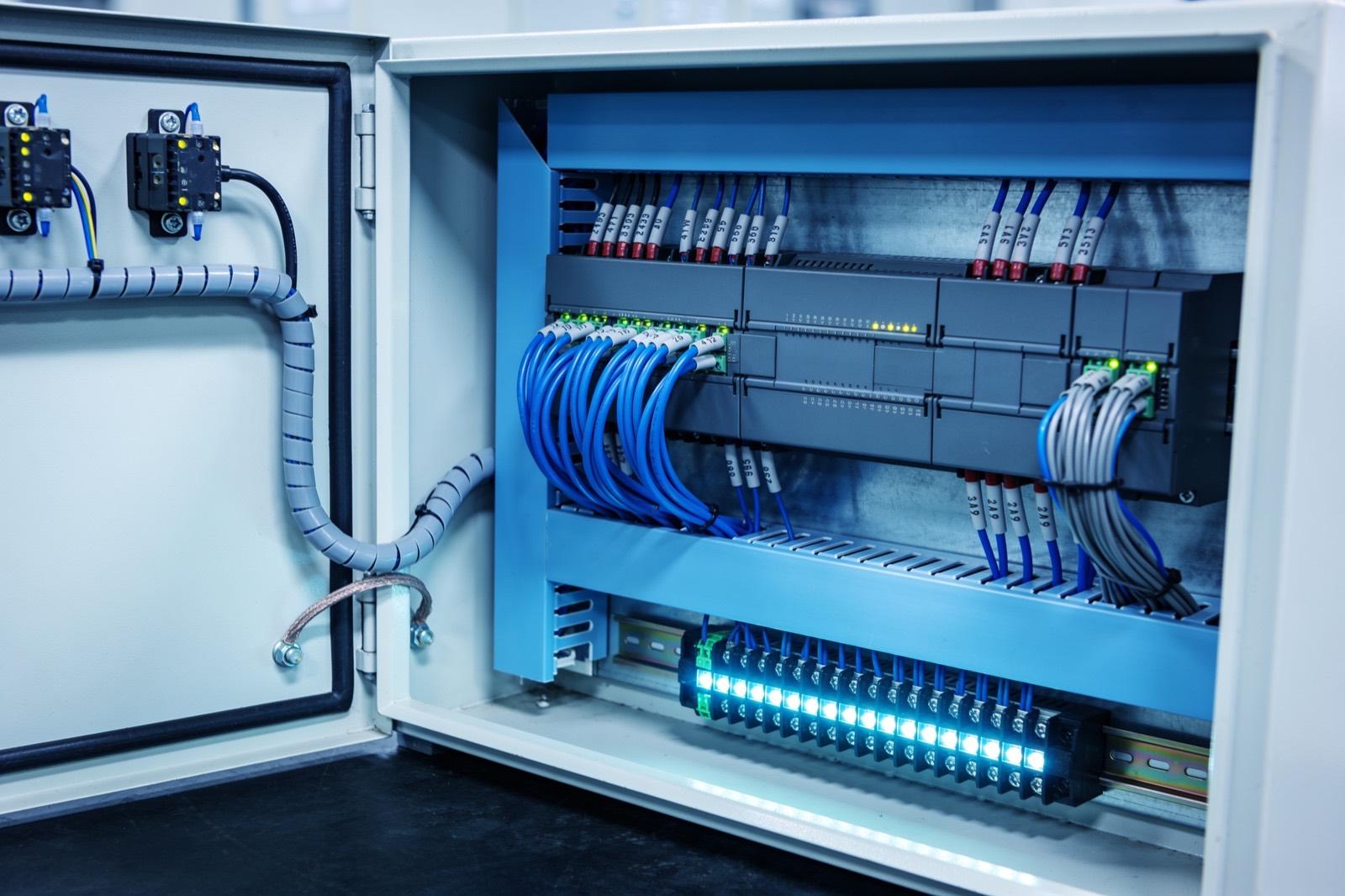 Industrial Automation
How the work gets done
The same way every time: scope, build, hand over.
Implementation spans the stack: PLC programming for Allen-Bradley, Siemens, and other platforms, HMI design operators can actually use, servo and VFD motion control, safety systems engineered to category — light curtains, e-stops, safety relays and safety PLCs — and the integration layer that ties new automation into existing equipment over Ethernet/IP or Profinet. Where robots fit, we handle cell design, end-of-arm tooling selection, and the fixturing that usually decides whether the cell hits rate.
A successful project is measured at the line, weeks in: cycle time against target, first-pass yield, uptime, and whether operators trust the system enough to stop babysitting it. We commission against a written acceptance test, train the people who will run and maintain the system, and leave documentation that lets your team troubleshoot without a phone call — though we answer the phone.
Scoping starts on the floor, not in a conference room. We walk the line with the people who run it, time the step in question across shifts, and pull whatever data already exists — scrap logs, downtime records, maintenance history — before anyone sketches a layout. Site walks also surface what drawings leave out: the column that limits robot reach, the compressed-air drop already at capacity, the panel with no spare I/O. From that we write a functional specification your team reviews and signs before design begins, so the cell we build is the cell you expected, and the acceptance test is agreed while it can still change the design.
Safety functions stay in safety-rated hardware. E-stops, guard interlocks, light curtains, and zone control run through safety relays or a safety PLC, never through standard logic that could be edited or bypassed, and we document the risk assessment and validation for each function. Commissioning is planned around your production calendar — typically a weekend or a scheduled shutdown for cutover, with dry runs on a staged panel beforehand so floor time is spent verifying rather than debugging. Handover includes commented source code, marked-up electrical drawings, a fault and recovery runbook, and hands-on training for operators and maintenance.
Scope it in writing
What we agree before work starts
- Process assessment with constraint analysis and payback estimate
- PLC and HMI programming with documented logic
Build with checkpoints
Working results, not slide decks
- Safety system design and validation
- Integration with existing equipment and controls
Hand over something you own
Documentation, source, and training
- Commissioning with written acceptance tests and operator training
- Electrical drawings, panel layouts, and network diagrams as built
Sound familiar?
Where manufacturing automation earns its keep.
A packout station where three people do what a machine and one person could
A weld cell whose quality depends entirely on which shift is running
A line that cannot add capacity without a building expansion
A manual inspection step that lets one bad part per thousand through
Ask about Manufacturing Automation
Describe the problem. Get a straight answer.
One line is enough. An engineer replies within a business day.
Related work
Radar centering system for steel mills
Components:
- Radar sensors (strip position): Non-contact radar reading strip edge position in a hot, dusty, vibrating environment where optical sensors fail.
- Edge controller (signal processing): Turns raw radar returns into a clean lateral offset in real time.
- Mill PLC (centering actuators): The mill's existing controller: receives the offset and drives the centering actuators.
- Operator HMI (live position): Live strip position for the operator.
Connections:
- Radar sensors to Edge controller (raw returns)
- Edge controller to Mill PLC (offset)
- Edge controller to Operator HMI
A steel-mill systems provider · Steel manufacturing
Radar-based centering system for steel mills
End-to-end engineering of a radar sensing system that measures and centers material on steel mill lines — from equipment assessment through hardware selection, electrical engineering, software, installation, and commissioning.
Read the case study →Common questions
Asked before every manufacturing automation project.
How do we know automation will actually pay back?
You calculate it before you commit. We quantify current cycle time, scrap, and labor for the targeted step, then model the automated version with realistic uptime assumptions. If the math does not clear your hurdle rate, we say so — a smaller intervention often beats the full cell.
Will new automation work with our existing machines?
That is usually the core of the project. Most equipment can be integrated through its PLC over Ethernet/IP or Profinet, through discrete I/O, or in stubborn cases through added sensors. We design the interface around what your machines expose, not around an assumption that everything is new.
What happens when it faults at 2 a.m. and you are not here?
Your team fixes it — that is a design requirement. Fault messages on the HMI say what is wrong in plain language, the documentation maps every fault to a procedure, and training covers the common failures. Systems only the integrator can service are a design failure we take seriously.
How much production downtime does installation require?
Less than most people expect, if it is planned for. Most fabrication, panel building, and programming happens off-line, and we test against simulated I/O before anything ships. The cutover itself — mechanical install, wiring, and commissioning — is usually scheduled into a weekend or planned shutdown, and we agree the plan and a rollback path with your team beforehand. Where a step cannot be staged, we say so in scoping rather than discovering it on the floor.
Which PLC platform should we use?
Usually the one your maintenance team already knows. Allen-Bradley and Siemens dominate for good reason — parts availability, local support, and a labor pool that can service them — but the right answer depends on what is already in your plant and who will maintain it at 2 a.m. We program what you standardize on, and if you have no standard yet, we help you pick one with the next decade of support in mind.

Where this sits
Manufacturing Automation, inside a industrial automation system.
The lit component is the part of the system this service delivers; the rest is what it has to work with.
Hover or focus a component to see what it is and what it talks to. Arrow keys move between them.
Sensors and machines report into the PLC; the PLC drives the HMI and publishes tags to a historian; the historian feeds dashboards and, where it exists, the MES.
Components:
- Machine (press, cell, line): The equipment itself. Newer machines expose tags; older ones need a sensor or a serial tap.
- Sensors (counts, temps, current): Retrofit sensors where the machine offers nothing: proximity counts, current transformers, temperature.
- PLC (control): The controller: logic, safety, and the tag table everything else reads.
- HMI (operator): Operator screen at the machine.
- Historian (tag store): Time-series store of PLC tags: uptime, counts, faults, cycle times.
- Dashboards (OEE, downtime): Plant TV and office views: OEE, downtime reasons, shift comparison.
- MES / ERP (orders): Work orders down, production counts up.
Connections:
- Sensors to PLC over 4-20mA
- Machine to PLC over EtherNet/IP
- PLC to HMI over EtherNet/IP
- PLC to Historian over OPC-UA
- Historian to Dashboards over REST
- Historian to MES / ERP over REST, both directions
Strategy. Software. Systems.
Have a system that should exist?
Tell us what your operation is doing manually, what isn't connected, or what you're trying to build. We'll tell you plainly whether and how we can help.