
Sensing that keeps working through dust, steam, and darkness
Radar measures distance, presence, and velocity using radio waves, which means it keeps working where optical sensors give up: through dust clouds, steam, fog, rain, and total darkness. If your ultrasonic level sensor drifts with temperature or your photo-eye fouls weekly, radar removes that entire failure mode.
Willowark builds sensing solutions around modern FMCW mmWave radar modules in the 60 and 77 GHz bands — the same core technology proven in automotive at enormous scale, now practical for industrial products and retrofits. We handle antenna and beamwidth selection, signal processing, and integration into your controls.
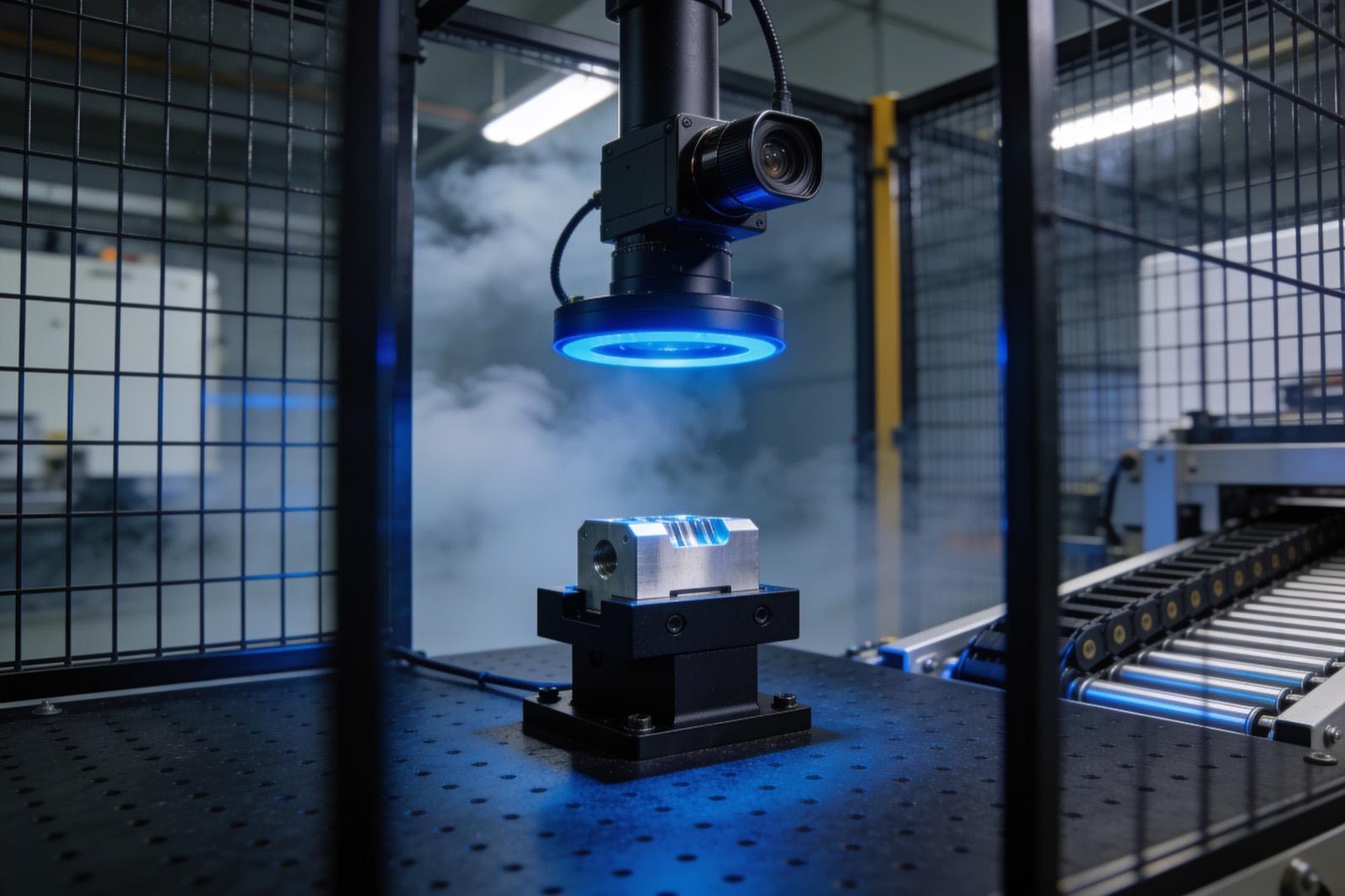 Vision & Advanced Sensing
How the work gets done
The same way every time: scope, build, hand over.
An FMCW radar sweeps a chirp of frequencies and measures the beat between transmitted and reflected signals: range falls out of the frequency difference, velocity out of the Doppler shift, and range resolution is set by chirp bandwidth. The engineering work is in configuring chirps for your geometry, then processing honestly — clutter mapping to ignore fixed structure, CFAR detection to keep false alarms bounded, and tracking filters to turn raw detections into stable object reports. Sensors mount in IP-rated housings and talk to the rest of the system over CAN, RS-485, or Ethernet.
We validate against the real environment, not a clean lab: actual material surfaces for level measurement, real dust loading, real traffic patterns. Success is measured in detection probability and false-alarm rate over weeks of operation, with radar data feeding your PLC or SCADA like any other well-behaved instrument. Where radar alone is ambiguous, it pairs naturally with cameras or other sensors through fusion.
Radar feasibility starts on site, because the environment is the sensor's specification. We look at where the sensor can mount, what sits inside the beam — ladders, agitators, structural steel, conveyor frames — and what the target is made of, since low-reflectivity materials such as dry plastics or fine powders return less signal than metal or water. Where possible we install a candidate module for a short trial and record raw detections through normal operation, including the messy periods: filling, cleaning, shift changes. That recording tells us the required chirp configuration and filtering, and whether a different mounting position or a second sensor would remove ambiguity before the design is fixed.
Product integrations extend the work into firmware and compliance. We write the radar processing to run on the module's processor or a microcontroller, with configurable detection zones, hysteresis, and reporting rates so one build serves many installations. Off-the-shelf modules typically carry regulatory approval for their band, and antenna or radome changes can affect it, so we design enclosures and radomes with that in mind and test them rather than assume — radome material and thickness change the beam more than expected. Handover includes the firmware source, a tuning guide explaining each parameter, and a commissioning checklist so field technicians can set zones and verify detection on site without an engineer present.
Scope it in writing
What we agree before work starts
- Application feasibility assessment with radar propagation and mounting analysis
- Sensor module selection and antenna or beam configuration
Build with checkpoints
Working results, not slide decks
- Signal processing firmware: detection, tracking, and filtering
- Environmental packaging and mounting design
Hand over something you own
Documentation, source, and training
- PLC, SCADA, or product integration over CAN, RS-485, or Ethernet
- On-site validation with documented detection and false-alarm performance
Sound familiar?
Where radar sensing earns its keep.
Silo and tank level measurement through dust and vapor
Vehicle detection and speed measurement in yards and gates
Occupancy and motion detection where cameras raise privacy concerns
Flow and blockage detection on conveyors carrying dusty material
Ask about Radar Sensing
Describe the problem. Get a straight answer.
One line is enough. An engineer replies within a business day.
Related work
Radar centering system for steel mills
Components:
- Radar sensors (strip position): Non-contact radar reading strip edge position in a hot, dusty, vibrating environment where optical sensors fail.
- Edge controller (signal processing): Turns raw radar returns into a clean lateral offset in real time.
- Mill PLC (centering actuators): The mill's existing controller: receives the offset and drives the centering actuators.
- Operator HMI (live position): Live strip position for the operator.
Connections:
- Radar sensors to Edge controller (raw returns)
- Edge controller to Mill PLC (offset)
- Edge controller to Operator HMI
A steel-mill systems provider · Steel manufacturing
Radar-based centering system for steel mills
End-to-end engineering of a radar sensing system that measures and centers material on steel mill lines — from equipment assessment through hardware selection, electrical engineering, software, installation, and commissioning.
Read the case study →Common questions
Asked before every radar sensing project.
When does radar beat ultrasonic or lidar?
Radar wins in contaminated air and on temperature-swinging sites: ultrasonic drifts with air temperature and fails in foam and vapor, while lidar scatters off dust and fog. Lidar still wins on angular resolution and ultrasonic on cost for short, clean ranges. We pick based on your environment, and sometimes the answer is a combination.
Can radar detect people around equipment?
Yes — mmWave radar detects human presence and motion reliably, and it does so without capturing identifiable images, which matters in privacy-sensitive spaces. One important boundary: unless a device carries a functional safety rating, we apply it for awareness, alarms, and automation, never as a substitute for rated safeguarding.
How accurate is industrial radar?
Modern FMCW level sensors resolve to millimeters under good conditions, and detection-oriented sensors localize objects to centimeters at tens of meters. Real accuracy depends on chirp bandwidth, target reflectivity, and multipath in your environment, so we state expected performance during design and verify it on site.
Will radar interfere with other equipment, or be interfered with?
Rarely, but it is checked rather than assumed. 60 and 77 GHz modules operate in bands set aside for this kind of sensing, at low power, and their signals do not penetrate walls or metal enclosures meaningfully. Multiple radars pointed at the same volume can interfere with each other, which we handle through chirp timing, frequency offsets, or mounting geometry. Existing plant Wi-Fi, PLCs, and drives operate far away in frequency and are not typically affected.
Can radar measure level in a tank with foam, agitators, or a conical bottom?
Usually, with configuration. Foam attenuates the signal, so the sensor and chirp bandwidth are chosen for margin; agitators and internal structure are handled with clutter mapping so fixed echoes are ignored; a conical bottom reduces returns near empty, which we characterize during the trial so the empty point is defined honestly. Level measurement in a difficult vessel is a common radar application, and the site trial is what tells us how much margin your specific vessel leaves.


Where this sits
Radar Sensing, inside a vision & advanced sensing system.
The whole system this service belongs to. Hover or focus a component to see what it is and what it talks to.
Hover or focus a component to see what it is and what it talks to. Arrow keys move between them.
A part is presented under controlled lighting, a camera captures a frame per trigger, inspection compute decides, the PLC rejects, and every result lands in a database that feeds SPC dashboards.
Components:
- Part (on conveyor): Presentation is half the problem: fixturing, orientation and cycle time decide what is possible.
- Lighting (ring / backlight): Chosen for the defect, not the camera. Lighting is where most vision projects are won or lost.
- Camera (GigE, triggered): Machine vision camera, hardware-triggered per part.
- Inspection compute (edge PC): Runs the inspection — classical tools, a trained model, or both — within cycle time.
- Line PLC (reject / accept): Acts on the verdict: reject gate, line stop, or count.
- Results DB (every part): Every inspection result, with the image reference, for traceability and SPC.
- SPC dashboard (trends): Escape rate, false-reject rate and drift over time.
Connections:
- Part to Camera over digital I/O (trigger)
- Lighting to Camera
- Camera to Inspection compute over GigE
- Inspection compute to Line PLC over digital I/O
- Inspection compute to Results DB over SQL
- Results DB to SPC dashboard over REST
Strategy. Software. Systems.
Have a system that should exist?
Tell us what your operation is doing manually, what isn't connected, or what you're trying to build. We'll tell you plainly whether and how we can help.