
When a flat image isn't enough, measure the third dimension
3D vision adds depth to machine perception: instead of a flat image, the system produces a point cloud that captures height, shape, and volume. That removes an entire class of problems 2D cameras cannot solve — overlapping parts in a bin, fill volume in a container, warpage across a surface, or a robot that needs to know exactly where to grip.
Willowark matches the 3D technology to the job rather than forcing one sensor everywhere. Structured light delivers fine detail on stationary scenes, laser profilers excel on moving product, time-of-flight cameras trade resolution for speed and range, and calibrated stereo fills gaps between them. The physics of your parts and motion decide.
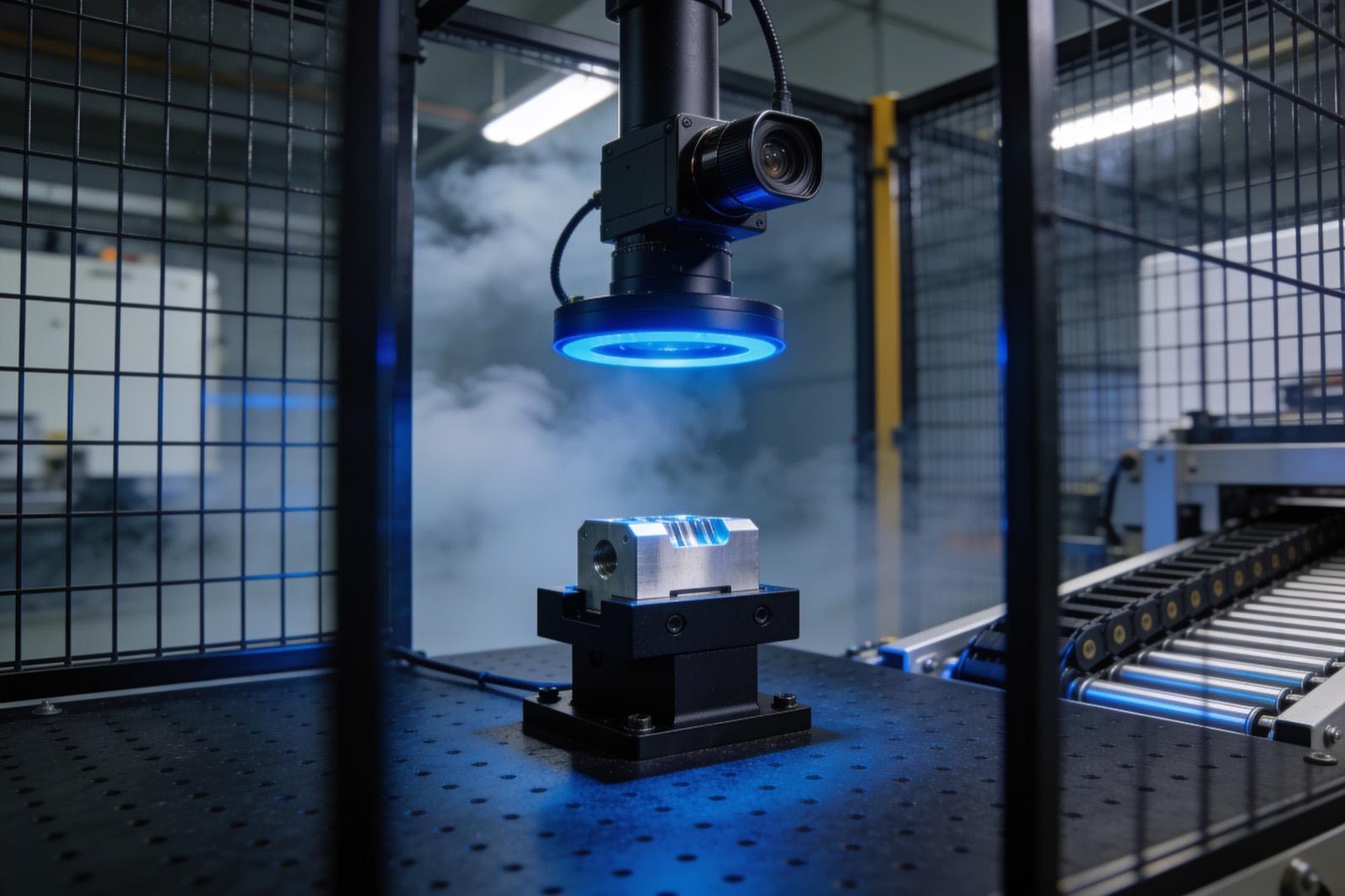 Vision & Advanced Sensing
How the work gets done
The same way every time: scope, build, hand over.
The raw output of any 3D sensor is a point cloud, and the real engineering happens after capture. Intrinsic calibration corrects the sensor; hand-eye calibration ties its coordinate frame to a robot's so a detected grasp point becomes an accurate move; registration algorithms like ICP align multiple views into one model. Processing pipelines built on PCL, Open3D, and GPU compute segment parts from bins, fit planes and cylinders to surfaces, and compute volumes against reference geometry. Ambient light robustness, dark and specular surfaces, and cycle-time budgets shape every one of those choices.
Production metrics are unforgiving and useful: pick success rate and cycle time for robot guidance, volume accuracy against reference objects for dimensioning, detection repeatability for inspection. We design mis-pick recovery — re-scan, re-grasp, alarm — so a failed pick costs seconds rather than a stopped cell, and we validate accuracy with traceable artifacts before the system owns a production decision.
Scan trials come first because 3D sensors trade resolution, field of view, and acquisition time against each other in ways brochures do not show. A sensor that resolves fine detail on a small part may need several seconds per scan and a working volume too small for your bin; a fast wide-field sensor may miss the edge you need to find. During feasibility we scan your parts in representative poses and containers, measure point density and noise on the surfaces that matter, and time the capture-to-result loop against your cycle budget. The outcome is a written recommendation with the trade-offs stated, including any parts that the technology handles poorly.
Integration with the cell is where 3D systems succeed or stall. The processing pipeline runs on an industrial PC and exchanges poses, results, and status with the robot controller and PLC over the protocols they speak, with handshakes so a slow scan never leaves the robot waiting on an undefined state. Point clouds and detection results are logged per cycle, which makes a mis-pick reviewable rather than anecdotal. Because sensors and robots get bumped, we deliver a re-calibration procedure using a fixed target that a technician can run in minutes, plus the source code and configuration so your engineers can add a new part or container without starting over.
Scope it in writing
What we agree before work starts
- 3D technology selection with scan trials on your parts
- Sensor, optics, and mounting design for the working volume
Build with checkpoints
Working results, not slide decks
- Point cloud processing pipeline for detection, fitting, or measurement
- Robot integration with hand-eye calibration where applicable
Hand over something you own
Documentation, source, and training
- Accuracy validation against reference artifacts
- Commissioning with documented pick-rate or measurement performance
Sound familiar?
Where 3d vision & depth sensing earns its keep.
Random bin picking of unordered parts with a robot
Pallet and package dimensioning for logistics
Fill level and portion volume measurement in food production
Flatness and warpage inspection on boards, panels, and castings
Ask about 3D Vision & Depth Sensing
Describe the problem. Get a straight answer.
One line is enough. An engineer replies within a business day.
Related work
Radar centering system for steel mills
Components:
- Radar sensors (strip position): Non-contact radar reading strip edge position in a hot, dusty, vibrating environment where optical sensors fail.
- Edge controller (signal processing): Turns raw radar returns into a clean lateral offset in real time.
- Mill PLC (centering actuators): The mill's existing controller: receives the offset and drives the centering actuators.
- Operator HMI (live position): Live strip position for the operator.
Connections:
- Radar sensors to Edge controller (raw returns)
- Edge controller to Mill PLC (offset)
- Edge controller to Operator HMI
A steel-mill systems provider · Steel manufacturing
Radar-based centering system for steel mills
End-to-end engineering of a radar sensing system that measures and centers material on steel mill lines — from equipment assessment through hardware selection, electrical engineering, software, installation, and commissioning.
Read the case study →Common questions
Asked before every 3d vision & depth sensing project.
Which 3D technology is right for our application?
It depends on resolution, standoff distance, and whether the part is moving. Structured light gives the finest static detail, laser profilers are the default for product on a conveyor, and time-of-flight suits fast, coarse volumetric jobs. We run scan trials on your parts during feasibility so the choice is based on data, not brochures.
Can 3D vision handle shiny or dark parts?
Often, with care. Specular and light-absorbing surfaces degrade most 3D sensors, but exposure fusion, polarization, sensor angle, and multi-view capture recover many difficult parts. Some materials remain genuinely hard, and the honest answer comes from scanning your parts early — which is why trials come before hardware purchases.
How hard is the robot integration side?
It is well-trodden ground when done in the right order: calibrate the sensor, perform hand-eye calibration to the robot frame, and verify with touch-off tests before running product. We work with the major robot brands and handle collision-aware grasp selection and mis-pick recovery as part of the deployment, not as afterthoughts.
What does 3D vision cost compared to 2D?
More, usually — the sensors are more expensive, the processing needs more compute, and the integration involves calibration steps 2D does not. That is why we ask first whether the problem is genuinely three-dimensional. Parts that always arrive in a known orientation on a flat surface often do not need it. When depth is what makes the task solvable at all, the added cost is typically small next to the cell it enables.
How do you handle new parts or containers after the system is running?
Depends on the approach. Model-based detection needs a CAD model or a reference scan of the new part and a short verification run; learned or geometry-based approaches may need a few example scans. New containers usually mean updating the working volume and collision geometry. We document the add-a-part procedure and walk your engineers through it during commissioning so the first new part after handover is done with us watching, and the second is done without us.

Where this sits
3D Vision & Depth Sensing, inside a vision & advanced sensing system.
The lit component is the part of the system this service delivers; the rest is what it has to work with.
Hover or focus a component to see what it is and what it talks to. Arrow keys move between them.
A part is presented under controlled lighting, a camera captures a frame per trigger, inspection compute decides, the PLC rejects, and every result lands in a database that feeds SPC dashboards.
Components:
- Part (on conveyor): Presentation is half the problem: fixturing, orientation and cycle time decide what is possible.
- Lighting (ring / backlight): Chosen for the defect, not the camera. Lighting is where most vision projects are won or lost.
- Camera (GigE, triggered): Machine vision camera, hardware-triggered per part.
- Inspection compute (edge PC): Runs the inspection — classical tools, a trained model, or both — within cycle time.
- Line PLC (reject / accept): Acts on the verdict: reject gate, line stop, or count.
- Results DB (every part): Every inspection result, with the image reference, for traceability and SPC.
- SPC dashboard (trends): Escape rate, false-reject rate and drift over time.
Connections:
- Part to Camera over digital I/O (trigger)
- Lighting to Camera
- Camera to Inspection compute over GigE
- Inspection compute to Line PLC over digital I/O
- Inspection compute to Results DB over SQL
- Results DB to SPC dashboard over REST
Strategy. Software. Systems.
Have a system that should exist?
Tell us what your operation is doing manually, what isn't connected, or what you're trying to build. We'll tell you plainly whether and how we can help.