
From Raspberry Pi prototype to hardware you can actually deploy
The Raspberry Pi is a genuinely capable industrial platform — when it is hardened. The gap between a bench prototype and a deployable system is where projects die: corrupted SD cards after power cuts, hung processes nobody notices, and a bare board zip-tied inside a panel. Engineering that gap closed is what this service removes from your plate.
Willowark treats Pi-based systems as embedded products. That usually means the Compute Module on an industrial carrier board rather than a consumer board, an operating system image built for unattended operation, and packaging that belongs in a control panel.
 IoT & Smart Systems
How the work gets done
The same way every time: scope, build, hand over.
Hardening starts with storage and power: eMMC or high-endurance media instead of consumer SD cards, a read-only root filesystem with an overlay so sudden power loss cannot corrupt the OS, and supervised shutdown or supercapacitor ride-through where writes matter. The hardware watchdog is enabled and fed by the application, so a hung process means an automatic recovery instead of a truck roll. A real-time clock keeps timestamps honest offline. Around the board: DIN-rail enclosures, isolated RS-485 and CAN interfaces for industrial buses, properly fused power, and screw-terminal I/O instead of jumper wires.
Fleet operation is designed in, not bolted on. Every unit runs a versioned, reproducible image; updates deploy remotely with rollback if the new image fails to boot; and device health — temperature, storage wear, connectivity — reports to a dashboard. When a product outgrows the platform, the migration path to a custom carrier or full custom board is straightforward because the software was built portable from the start.
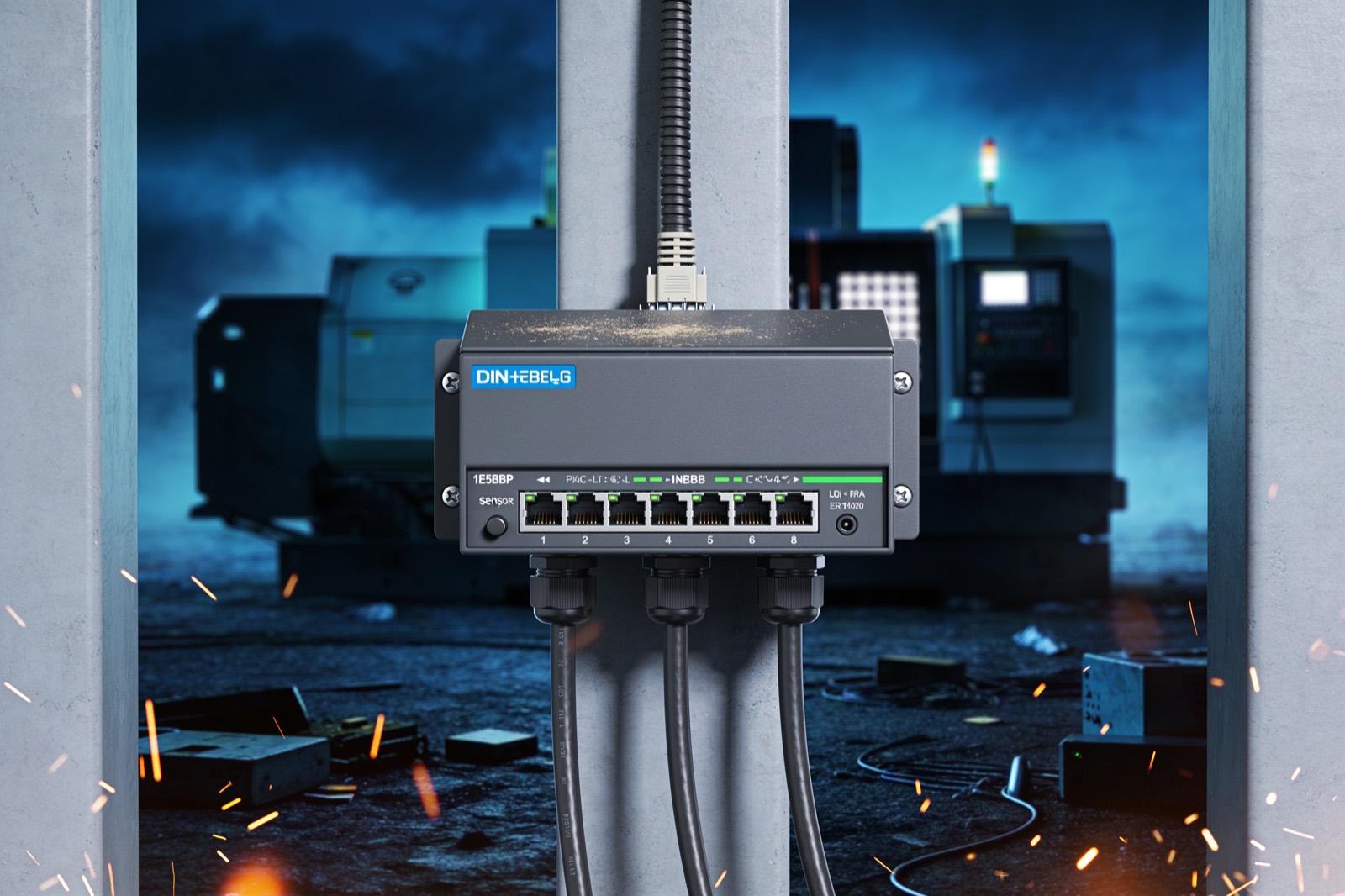
Hardware selection leans on off-the-shelf industrial parts before anything custom. Several vendors sell DIN-rail Compute Module carriers with isolated I/O, wide-range power input, and proper connectors; where one fits, it saves the cost and schedule of a board spin and comes with a vendor standing behind the hardware. Custom carriers are reserved for cases where the off-the-shelf options miss a peripheral, a form factor, or a price point. Connectivity follows the site: wired Ethernet whenever a cable can reach, with Wi-Fi, cellular modems, or LoRa hats where it cannot, and power-over-Ethernet where it simplifies installation.
The application layer is built to behave without a network. Local logic runs whether or not the cloud is reachable, readings buffer to local storage and forward when the link returns, and the touchscreen or local web interface keeps working for whoever is standing at the machine. Data leaves the device over MQTT or a plain HTTP API into databases you own, never through a proprietary agent. At handover you receive the image build scripts, application source, wiring diagrams, and a runbook covering re-imaging a unit, swapping a failed module, and reading the health dashboard — so your own technicians can service the fleet without calling us first.
Scope it in writing
What we agree before work starts
- Hardware design: Compute Module carrier selection or custom carrier board
- Hardened OS image with read-only root and hardware watchdog
Build with checkpoints
Working results, not slide decks
- Application software and industrial I/O integration
- DIN-rail or environmental enclosure and wiring design
Hand over something you own
Documentation, source, and training
- Remote update system with automatic rollback
- Fleet provisioning and health monitoring
Sound familiar?
Where raspberry pi systems earns its keep.
Machine data collectors bridging equipment to a network
Touchscreen HMI and kiosk controllers
Camera nodes for monitoring and inspection tasks
Instrument controllers inside lab and test equipment
Ask about Raspberry Pi Systems
Describe the problem. Get a straight answer.
One line is enough. An engineer replies within a business day.
Related work
Radar centering system for steel mills
Components:
- Radar sensors (strip position): Non-contact radar reading strip edge position in a hot, dusty, vibrating environment where optical sensors fail.
- Edge controller (signal processing): Turns raw radar returns into a clean lateral offset in real time.
- Mill PLC (centering actuators): The mill's existing controller: receives the offset and drives the centering actuators.
- Operator HMI (live position): Live strip position for the operator.
Connections:
- Radar sensors to Edge controller (raw returns)
- Edge controller to Mill PLC (offset)
- Edge controller to Operator HMI
A steel-mill systems provider · Steel manufacturing
Radar-based centering system for steel mills
End-to-end engineering of a radar sensing system that measures and centers material on steel mill lines — from equipment assessment through hardware selection, electrical engineering, software, installation, and commissioning.
Read the case study →Common questions
Asked before every raspberry pi systems project.
Is a Raspberry Pi really reliable enough for industrial use?
The silicon is; the typical setup around it is not. A consumer board with a desktop OS on an SD card will disappoint you. A Compute Module on an industrial carrier, running a read-only image with a watchdog and clean power, routinely runs unattended for years. The reliability is in the system engineering, and that is the part we do.
What about supply and long-term availability?
Compute Modules carry multi-year availability commitments from Raspberry Pi, which is one reason we prefer them over consumer boards for products. We also design so the application does not depend on one board: if you ever need to move to a different module or a custom design, the software carries over.
When should we skip the Pi and go to custom hardware?
When unit volumes make the per-unit cost matter more than development cost, when you need capabilities the platform lacks — very low power, odd peripherals, extreme temperature — or when certification demands full hardware control. We will tell you when you have crossed that line, and the Pi-based version still serves as your proven prototype.
Can you harden a Pi system we already built ourselves?
Usually, yes, and it is a common starting point. We audit the existing setup — storage, power, OS configuration, how the application starts and recovers — and then migrate it onto a hardened, reproducible image in stages, keeping your application code where it works. The typical outcome is the same functionality on a system that survives power cuts and can be re-imaged from a script, without a rewrite. Where the original board choice is the weak point, we will say so and propose the carrier swap.
How many units does this make sense for?
From one to a few hundred. A single hardened unit is worth engineering properly when it sits somewhere a failure is expensive to reach; the fleet tooling — provisioning, updates, health monitoring — pays off from roughly a handful of units upward. Above a few hundred, per-unit cost usually starts to argue for custom hardware, and the Pi-based design becomes the proven reference for that step. We size the tooling to the fleet you actually expect, not the one on the slide.


Where this sits
Raspberry Pi Systems, inside a iot & smart systems system.
The lit component is the part of the system this service delivers; the rest is what it has to work with.
Hover or focus a component to see what it is and what it talks to. Arrow keys move between them.
Field sensors report through an edge gateway to a broker; a time-series store feeds dashboards, and rules raise alerts that reach a person.
Components:
- Sensors (field): Temperature, vibration, level, current — wired or wireless.
- Edge gateway (DIN rail): Reads the sensors, buffers when the link is down, speaks MQTT upward.
- MQTT broker: Pub/sub hub; many gateways, many consumers.
- Time-series store: Every reading, retained for the trend and the audit.
- Rules engine (thresholds): Thresholds, rates of change, missing-heartbeat detection.
- Dashboard: Live and historical views.
- On-call phone: The alert reaches someone who can act.
Connections:
- Sensors to Edge gateway over Modbus
- Edge gateway to MQTT broker over MQTT
- MQTT broker to Time-series store over MQTT
- MQTT broker to Rules engine over MQTT
- Time-series store to Dashboard over REST
- Rules engine to On-call phone over push
Strategy. Software. Systems.
Have a system that should exist?
Tell us what your operation is doing manually, what isn't connected, or what you're trying to build. We'll tell you plainly whether and how we can help.