
Electronics, firmware, and software designed together — because they ship together
Hardware/software co-development runs the electrical, firmware, and application workstreams of a product in parallel, under one coordinated design, instead of in sequence under separate contracts. It removes the classic integration disaster: hardware arrives, software meets it for the first time, and the two teams spend a quarter discovering that a pin assignment, a timing budget, and a data format were all assumed differently.
Willowark structures these projects around the interfaces first. Before either side gets deep, we define the contracts that bind them — pinouts and electrical budgets, register maps and communication protocols, message schemas up to the application — and hold both sides to them. Because our engineers work across the boundary, the person writing the firmware can flag a board problem while the board is still schematics.
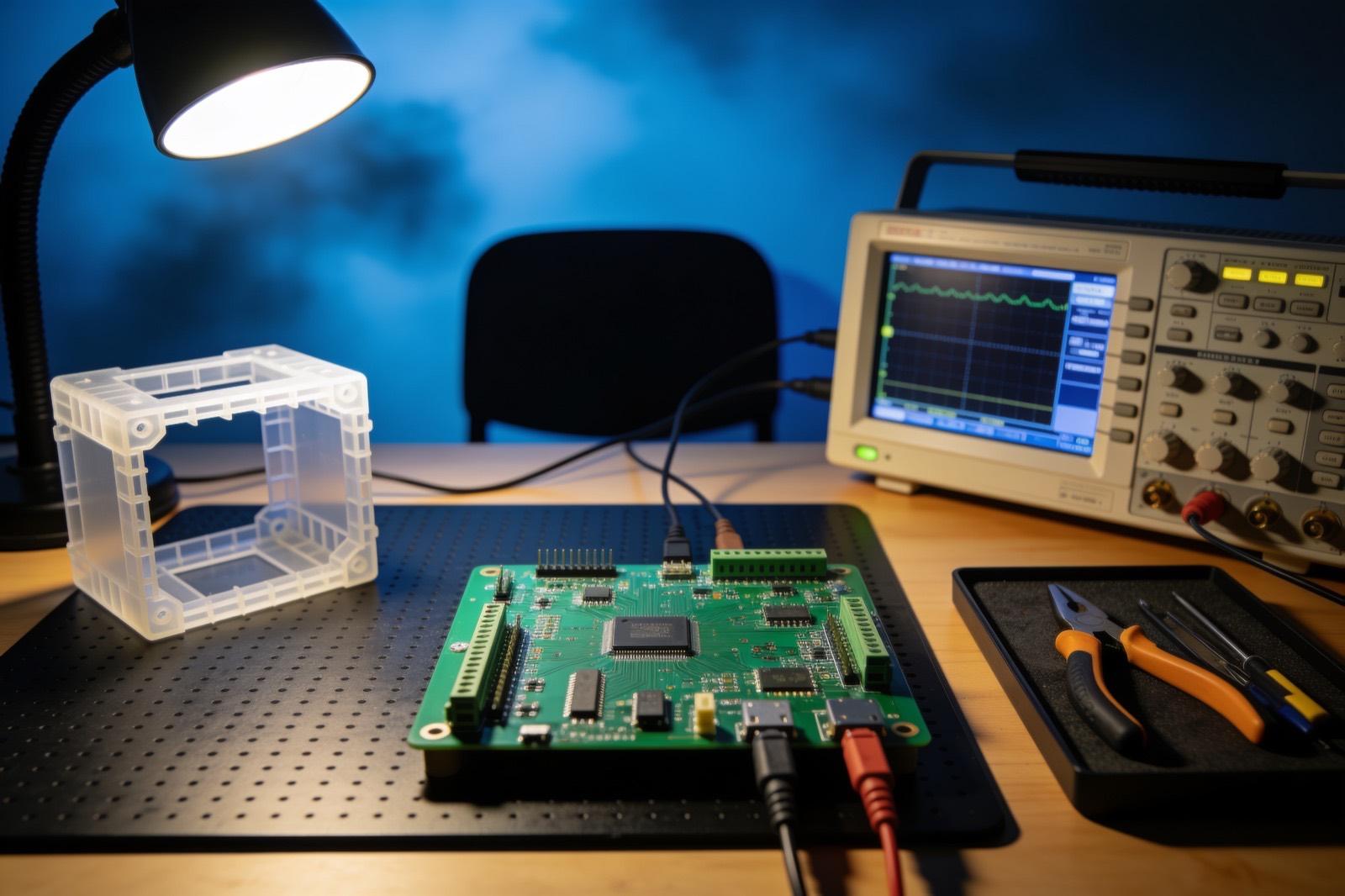 R&D & Prototyping
How the work gets done
The same way every time: scope, build, hand over.
In practice, co-development means the software team is productive months before real hardware exists: firmware runs against dev boards and simulated peripherals, application code runs against a device emulator that honors the agreed message schema, and hardware-in-the-loop begins the week first articles arrive rather than after a bring-up crisis. Board bring-up itself is planned as engineering, not hoping — test points and debug headers designed in, a bring-up checklist per subsystem, and firmware written to report what the silicon is actually doing. Requirements live in a matrix that maps each one to the layer responsible for it, so nothing important falls between teams.
The payoff shows at integration, which becomes an event measured in days, not months. Success looks like first-revision boards running meaningful firmware within the first week, an application demo on real hardware shortly after, and a change process where a mid-project requirement lands as a coordinated update across layers instead of a fight about whose problem it is.
The first weeks are spent on the decisions that are expensive to reverse: processor and radio selection, power architecture, the split of responsibility between firmware and application, and the update mechanism. Where a choice hinges on something uncertain — whether a microcontroller can keep up with the sampling rate while running the radio stack, whether a protocol survives a noisy link — we build a small test to settle it before the schematic depends on it. The system test plan is drafted in parallel, so that each layer's acceptance criteria are known while it is being designed rather than written after the fact.
The deliverable is a single coherent package rather than two vendors' handoffs: schematics and layout, firmware source with its build system, application source, the emulators and test harnesses, and the interface documents that tie them together, all in editable form and all yours. Because the interfaces were designed as versioned contracts, the product can evolve after we leave — a new sensor board, a firmware feature, a redesigned app — without the layers drifting apart. If the project continues into product engineering, the same interface documents become the specification the manufacturing test and the compliance work are built against.
Scope it in writing
What we agree before work starts
- Interface control documents: electrical, firmware, and application contracts
- Custom electronics design with schematics and layout
Build with checkpoints
Working results, not slide decks
- Firmware and application software developed against the shared contracts
- Emulators or simulation harnesses enabling pre-hardware software development
Hand over something you own
Documentation, source, and training
- Board bring-up plan, execution, and integrated system validation
- Requirements matrix allocating each requirement to the hardware, firmware, or application layer
Sound familiar?
Where hardware/software co-development earns its keep.
A connected device where the sensor board, firmware, and mobile-facing API all need building at once
A product whose previous vendor built hardware and software separately, and integration proved it
An instrument where power budget, sampling firmware, and analysis software all constrain each other
A tight timeline where waiting for finished hardware before starting software is not survivable
Ask about Hardware/Software Co-Development
Describe the problem. Get a straight answer.
One line is enough. An engineer replies within a business day.
Related work
X-ray thickness gauge
Components:
- X-ray source (+ detector): Source and detector pair measuring attenuation through the material.
- Acquisition (signal chain): Signal conditioning and acquisition.
- Gauge software (thickness model): Calibrated model converting attenuation to thickness.
- Line control (feedback): The line's controller, closing the loop on thickness.
Connections:
- X-ray source to Acquisition
- Acquisition to Gauge software (calibrated)
- Gauge software to Line control (thickness)
An industrial measurement company · Industrial measurement
X-ray thickness gauge
A complete X-ray based thickness gauge: equipment assessment, hardware selection, electrical and hardware engineering, API integration, all software, and commissioning — delivered as a working instrument.
Read the case study →Common questions
Asked before every hardware/software co-development project.
Why not just hire a hardware firm and a software firm separately?
It can work, but the interfaces between them become contract boundaries, and problems that live at the boundary — timing, power modes, protocol edge cases — become negotiations instead of engineering. One team responsible for the whole stack means those problems get fixed wherever the fix is cheapest, which is often on the other side of where the symptom appeared.
How does software development start before hardware exists?
Against stand-ins that honor the contract: development boards with the same MCU family, simulated peripherals, and emulators that speak the agreed protocol. Because the interface definitions are written first and versioned, code developed against the stand-ins carries to real hardware with modest, planned changes rather than a rewrite.
What happens when a requirement changes mid-project?
It gets assessed across the whole stack before anyone reacts, because a change that looks like software is sometimes cheapest in hardware and vice versa. The interface documents and requirements matrix are updated first, then each layer implements against the new contract. That order is the difference between a controlled change and drift.
Can you take over a project where the hardware is already designed?
Yes. We start by reading the board the way the firmware will see it — pin assignments, peripherals, power modes, debug access — and writing the interface document that should have existed. That usually surfaces a short list of things that are awkward but workable, and occasionally one that needs a board spin. Either way you get a clear picture before the software commitment is made, rather than discovering it during bring-up.
How do you keep the hardware and software schedules in step?
By planning around the hardware milestones that actually gate software, and giving software something to run on in between. Board fabrication and assembly lead times are the long pole, so we sequence the work so that firmware and application development stay productive on stand-ins while boards are in fabrication, and bring-up is staffed from both sides the week boards arrive. Slips still happen; the difference is that they are visible early and absorbed by resequencing rather than by idle engineers.


Where this sits
Hardware/Software Co-Development, inside a r&d & prototyping system.
The lit component is the part of the system this service delivers; the rest is what it has to work with.
Hover or focus a component to see what it is and what it talks to. Arrow keys move between them.
Requirements become a bench prototype with real sensors and firmware; a test rig produces data; a pilot unit runs in the field; and the design is handed to production with everything documented.
Components:
- Requirements: What it must measure, survive and cost.
- Bench prototype (MCU + sensors): Dev board, real sensors, real signal chain.
- Firmware: Acquisition, processing, comms, update path.
- Test rig (data): Instrumented tests against known references.
- Pilot unit (in the field): A handful of units where the product will live.
- Production (handoff): Drawings, BOM, test procedure, firmware — yours.
Connections:
- Requirements to Bench prototype over handoff
- Bench prototype to Firmware
- Firmware to Test rig over serial
- Test rig to Pilot unit over handoff
- Pilot unit to Production over handoff
Strategy. Software. Systems.
Have a system that should exist?
Tell us what your operation is doing manually, what isn't connected, or what you're trying to build. We'll tell you plainly whether and how we can help.