
Purpose-built rigs for questions no catalog product can answer
Experimental systems are one-off machines and instrumented rigs built to investigate something — a process, a material, a physical phenomenon — that no commercial instrument addresses. They remove the ceiling on your R&D: the point where the question your team needs to ask simply does not match any product a vendor sells.
Willowark builds these as scientific instruments first and machines second. The design starts from the measurement: what variable is being studied, what accuracy the conclusion requires, and what confounds could contaminate the result. Actuation, fixturing, sequencing, and safety are then engineered around protecting that measurement, because an experimental rig that produces untrustworthy data is worse than no rig at all.
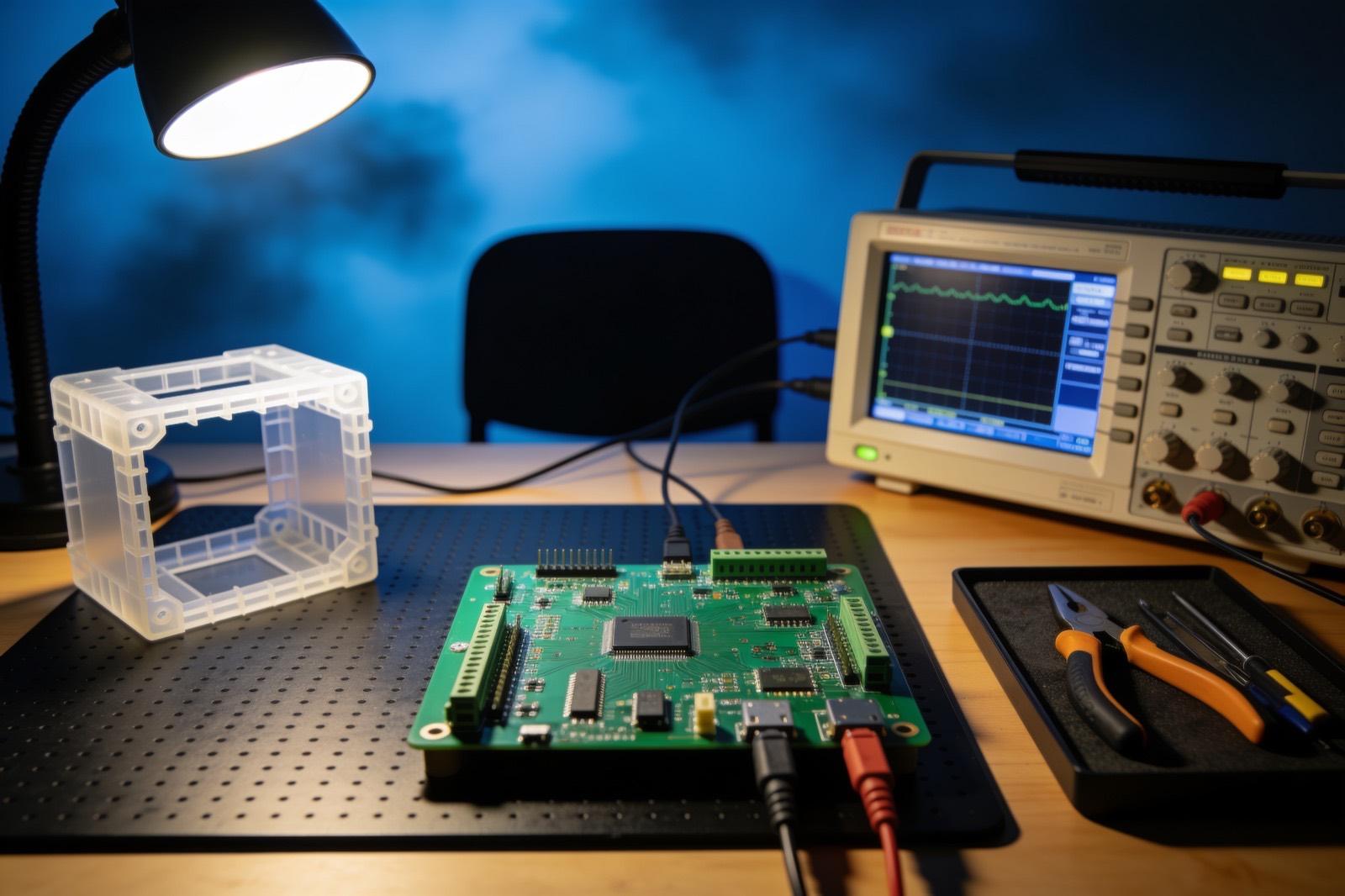 R&D & Prototyping
How the work gets done
The same way every time: scope, build, hand over.
A typical build combines motion or process actuation (stages, pumps, thermal control, custom mechanisms), sensing chosen for the science rather than the catalog page (load cells, thermocouples and RTDs, high-speed cameras, specialty transducers), and a DAQ and control layer that sequences experiments and records everything — including the conditions you did not think you cared about, because in six months you will. Software gives researchers parametric control: define a test matrix, run it unattended, and get every run logged with full configuration so results are reproducible. Calibration against traceable references is designed in, not bolted on.
In service, a good experimental system changes the tempo of R&D. Runs that took a day of manual babysitting execute overnight; parameter sweeps that were impractical become routine; and arguments about whether a result is real get settled by repeatability data instead of seniority. Success is measured in the quality of the papers, patents, or process decisions the data supports — and in how rarely anyone asks whether the rig can be trusted.
Before any metal is cut, we write the experiment the rig must be able to run: the variables under control, the ranges they must cover, the resolution and sample rate the analysis needs, and the number of runs the statistics require. That document decides the machine. A question that needs ten thousand cycles pushes toward automation and reliability; one that needs a few exquisite measurements pushes toward isolation and calibration. We also plan the commissioning tests — known samples, null runs, and repeated conditions — so that the first data the rig produces is a check on the rig itself, not on the science.
Sometimes the most valuable output is finding that an effect the team expected is not there, or that a variable thought to be irrelevant dominates. A rig built to protect the measurement makes those results believable rather than arguable. Every design file, drawing, schematic, and line of control software is delivered in editable form and belongs to you, along with the calibration records and the characterization data. If the rig later needs to become a routine test station, or a process it studied needs to become a production line, that package — including the documented decisions and known limitations — is where the next engineering phase starts.
Scope it in writing
What we agree before work starts
- Requirements document translating research questions into measurable specifications
- Custom rig or testbed: mechanical, electrical, and controls
Build with checkpoints
Working results, not slide decks
- Experiment control software with parametric test definition and full-run logging
- Calibration procedures against traceable references
Hand over something you own
Documentation, source, and training
- Operating documentation and training for the research team
- Complete design package: CAD, drawings, schematics, wiring, and control source
Sound familiar?
Where experimental systems earns its keep.
A materials team that needs cyclic loading under controlled temperature no commercial frame offers
A process developer studying how nozzle geometry affects coating uniformity across dozens of variables
A university lab that needs a custom apparatus built to publication-grade measurement standards
A product team characterizing a failure mode that only reproduces under a rare combination of conditions
Ask about Experimental Systems
Describe the problem. Get a straight answer.
One line is enough. An engineer replies within a business day.
Related work
X-ray thickness gauge
Components:
- X-ray source (+ detector): Source and detector pair measuring attenuation through the material.
- Acquisition (signal chain): Signal conditioning and acquisition.
- Gauge software (thickness model): Calibrated model converting attenuation to thickness.
- Line control (feedback): The line's controller, closing the loop on thickness.
Connections:
- X-ray source to Acquisition
- Acquisition to Gauge software (calibrated)
- Gauge software to Line control (thickness)
An industrial measurement company · Industrial measurement
X-ray thickness gauge
A complete X-ray based thickness gauge: equipment assessment, hardware selection, electrical and hardware engineering, API integration, all software, and commissioning — delivered as a working instrument.
Read the case study →Common questions
Asked before every experimental systems project.
How do we know the data from a one-off rig is valid?
Validation is part of the build, not an afterthought: sensors are calibrated against traceable references, the system is characterized for noise, drift, and repeatability, and where possible we run known cases with predictable outcomes before trusting novel ones. You receive that characterization data, so the rig's error bars are known quantities.
Our requirements will change as we learn. Can the system adapt?
It should — that is the nature of research. We design with modularity where change is likely: swappable fixtures, headroom in the DAQ channel count, and control software configured by parameters rather than hard-coded sequences. Mid-project discoveries usually mean a configuration change, not a rebuild.
Can you work under our lab's safety and review processes?
Yes. Experimental rigs often involve stored energy, thermal hazards, or chemistry, and we engineer interlocks, guarding, and emergency stops to the relevant standards, then document the system for your internal safety review. We would rather design the review requirements in from day one than retrofit them at commissioning.
We already have most of the components. Can you build around them?
Often, yes, and reusing a good frame, stage, or chamber can shorten the build. The caveat is that existing parts get the same scrutiny as new ones: we check whether the old load cell's accuracy or the existing stage's repeatability actually meets the measurement budget, and we say so if it does not. Sometimes the cheapest path is a new sensor in an old frame; sometimes the frame is the problem.
How is this different from buying a universal test machine and adding fixtures?
If a commercial instrument covers the measurement, buy it — we will tell you so, and can help with fixtures and software around it. A custom rig makes sense when the combination of variables, geometry, environment, or timing does not exist in any catalog, or when a commercial machine's control software cannot run the experiment the way the research needs. The decision usually comes down to whether the measurement or the machine is the thing being compromised.

Where this sits
Experimental Systems, inside a r&d & prototyping system.
The lit component is the part of the system this service delivers; the rest is what it has to work with.
Hover or focus a component to see what it is and what it talks to. Arrow keys move between them.
Requirements become a bench prototype with real sensors and firmware; a test rig produces data; a pilot unit runs in the field; and the design is handed to production with everything documented.
Components:
- Requirements: What it must measure, survive and cost.
- Bench prototype (MCU + sensors): Dev board, real sensors, real signal chain.
- Firmware: Acquisition, processing, comms, update path.
- Test rig (data): Instrumented tests against known references.
- Pilot unit (in the field): A handful of units where the product will live.
- Production (handoff): Drawings, BOM, test procedure, firmware — yours.
Connections:
- Requirements to Bench prototype over handoff
- Bench prototype to Firmware
- Firmware to Test rig over serial
- Test rig to Pilot unit over handoff
- Pilot unit to Production over handoff
Strategy. Software. Systems.
Have a system that should exist?
Tell us what your operation is doing manually, what isn't connected, or what you're trying to build. We'll tell you plainly whether and how we can help.